
In building services engineering, planners and electrical installers are looking for solutions that not only work today, but will still be relevant and expandable in ten or twenty years’ time. Lighting control is no longer just about switching lights on and off. It’s about reliability, scalability and, above all, investment security.
Many proprietary island systems promise intelligence, but create a technological dead end. This is exactly where the Bluetooth SIG Mesh Standard comes in. It is not a licensed, vendor-dependent product, but an open, global basis for control systems – the foundation on which professional systems such as STEINEL Connect are built.

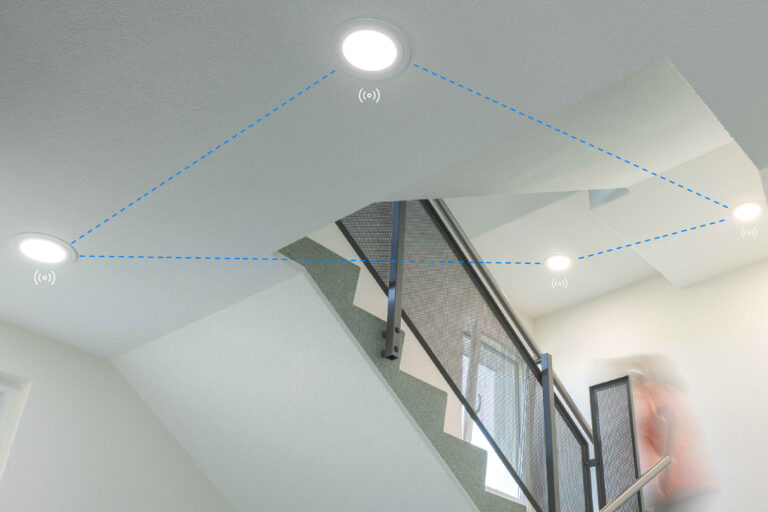
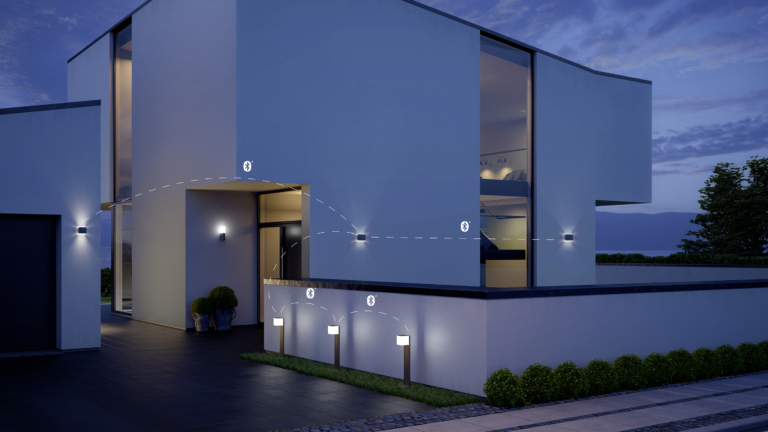
To understand why this standard is so robust, it is worth taking a look at its architecture. Unlike traditional Wi-Fi or simple Bluetooth connections, which often require a central control unit (such as a router or hub), Bluetooth Mesh operates in a decentralised manner. The difference can be likened to team communication:
Centralised system (star network): One person (the hub) speaks, while everyone else just listens. If this one person fails, all communication breaks down.
Decentralised system (mesh network): Everyone in the room can receive a message and pass it on to everyone else. The information always finds its way, even if someone leaves the room.
Every light, every sensor and every button in a Bluetooth Mesh network is such an active “node”. It sends, receives and forwards information. With a wink, one could say that we in Switzerland are very familiar with this principle: decentralised, federalist and extremely robust, because not everything depends on a single central authority. This “everyone-to-everyone principle” is the basis for a self-healing and extremely stable network without a central weak point (single point of failure).
This “everyone-to-everyone principle” is the basis for a self-healing and extremely stable network without a central weak point (single point of failure).
This technical architecture offers tangible advantages that are crucial for any professional construction or renovation project:
1. Maximum operational reliability
Since there is no central control unit that can fail, the system is inherently resilient. If a single light fails or the connection between two points is disrupted, the communication automatically finds an alternative route through the network. The result is operational reliability that is essential for all professional infrastructures.
2. Virtually unlimited scalability
A project may start with ten lights in a corridor. In a year’s time, the adjacent hall is to be added, followed later by the office building. With Bluetooth Mesh, this is no problem. Each new component is simply integrated into the existing network, extending its range and density. The system grows organically with the requirements.
3. Future-proofing through an open standard
This is a crucial point for every planner and investor. Bluetooth Mesh is an open standard managed by the global Bluetooth Special Interest Group (SIG). This means that your investment is based on a global technology that is supported and developed by hundreds of companies – not on the proprietary solution of a single company. The foundation of your installation cannot therefore become obsolete overnight. However, it is important to distinguish between the standard and the system ecosystem. While the standard provides the common language, the perfectly coordinated interaction of hardware and software (app) is crucial for smooth functioning in practice. For a professional installation with full functionality, guarantees and support, it is therefore essential to rely on components from a closed, tested system such as STEINEL Connect.
4. Efficiency in installation and operation
The decentralised, wireless nature of the network drastically reduces installation costs. No additional control cables need to be laid, which saves time and money, especially when renovating existing buildings. The entire configuration and subsequent adjustment of groups or scenes can be carried out flexibly via an app.
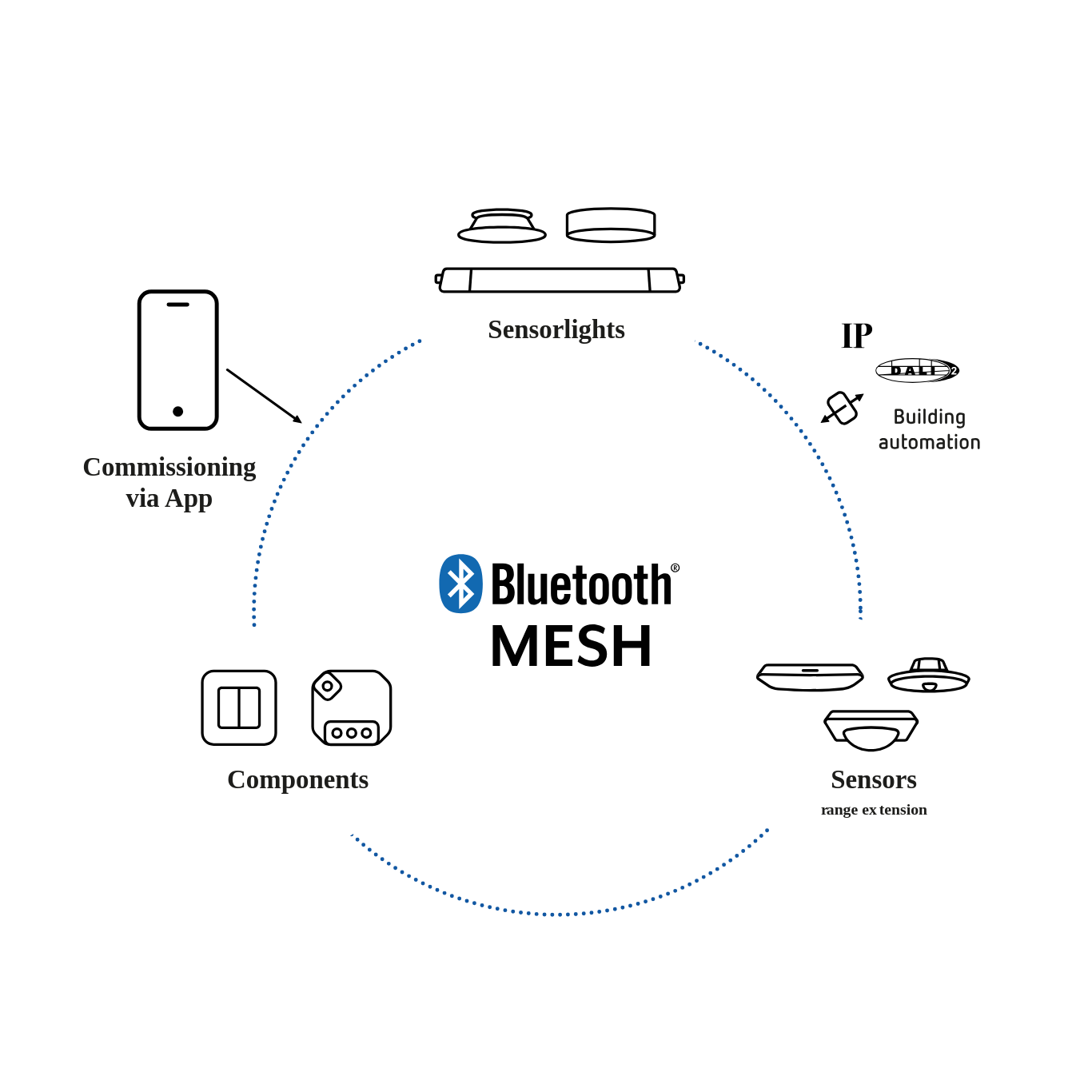
A solid standard is the foundation. A professional system such as STEINEL Connect builds on this with a well-designed ecosystem. It utilises the strength of the Bluetooth Mesh standard and supplements it with high-quality, perfectly coordinated components for practical use – from intelligent sensor lights to IP, KNX and DALI gateways and other system components and switching actuators such as relays, couplers and push buttons that bridge the gap to existing installations.
Choosing a lighting control system is a strategic decision. Instead of relying on closed, isolated solutions, the open Bluetooth SIG Mesh standard offers a stable, scalable and, above all, future-proof foundation. For planners, this means certainty in the specification; for installers, simplified implementation; and for builders, protection of their investment in a long-lasting technology. If you are looking for a system whose technological basis deserves trust today and tomorrow, there is no way around Bluetooth Mesh.

🔗 Do you have questions about using or planning with Bluetooth Mesh? Our experts will be happy to advise you.
And if you don’t believe us, believe Sheldon 🙂